
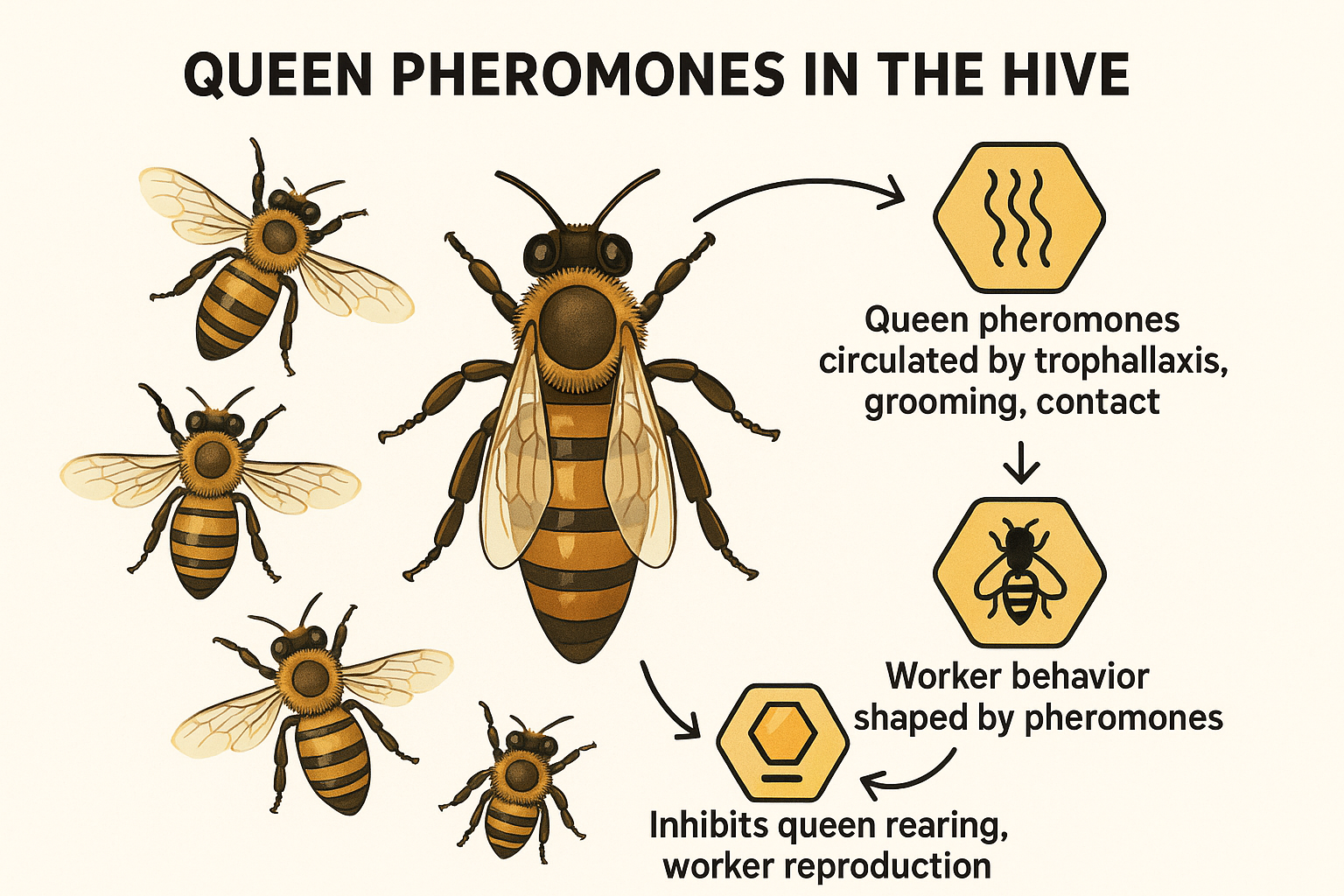
Honey bees communicate in a variety of ways to ensure the survival and success of their colony. These methods primarily involve a combination of physical movements (dances and vibrations) and chemical signals (pheromones). Honey bees use a complex system of pheromones to communicate and regulate their colony. Each caste (queen, worker, drone) and life stage (brood, larvae, egg) produces specific pheromones that influence the behavior and physiology of other bees. Queen Mandibular Pheromone (QMP) is crucial for colony cohesion and worker behavior, while alarm pheromones, released by workers, trigger defensive responses. Brood pheromones, produced by larvae, inhibit worker ovary development. Additionally, worker bees use pheromones for orientation, foraging, and recognizing eggs.
Pheromone Types:
Releaser Pheromones: These pheromones trigger immediate behavioral responses, such as alarm pheromones causing bees to become defensive.
Primer Pheromones: These pheromones cause long-term physiological and behavioral changes, such as QMP inhibiting worker ovary development or BEP affecting worker maturation.
Physiological Changes:
As worker bees age and transition from nursing to foraging, they undergo physiological changes, including hormonal shifts, that are associated with a greater responsiveness to alarm pheromones and a lower threshold for initiating defensive behaviors. For example, foragers have higher levels of juvenile hormone and lower levels of vitellogenin compared to nurse bees, a reversal of the hormonal profile observed in younger, less aggressive bees.
Here’s a breakdown of honey bee pheromones by caste and life stage:
Queen
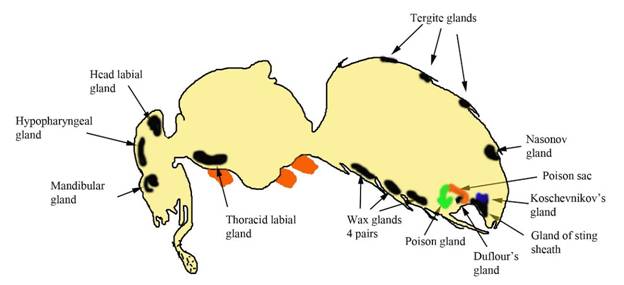
Queen Mandibular Pheromone (QMP): Produced by the queen’s mandibular glands, QMP is a complex blend of chemicals that is vital for colony cohesion and social order. It attracts worker bees, inhibits worker ovary development, suppresses queen cell construction, and influences foraging and comb building. QMP also plays a role in attracting drones during mating flights.
Tarsal Glands: Queens secrete a pheromone from their tarsal glands (located on their feet) as they walk, which inhibits worker bees from constructing queen cells.
Queen Retinue Pheromone (QRP): The queen is surrounded by a group of worker bees, known as the retinue, who tend to her needs. The retinue also helps disseminate QMP throughout the colony.
Worker
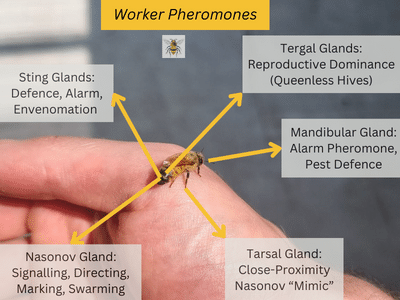
Alarm Pheromones: Worker bees produce two main alarm pheromones, which are released when the colony is threatened. These pheromones induce defensive behavior in other workers, such as stinging or approaching the source of the alarm.
Nasonov Pheromone: This pheromone, produced by the Nasonov gland, is used by worker bees to guide returning foragers back to the hive, especially in cases of swarming or disorientation.
Footprint Pheromone: As workers walk, they deposit a footprint pheromone that attracts and stimulates other workers. This pheromone is also used in orientation and foraging.
Forager Pheromone: Older worker bees release ethyl oleate, a pheromone that inhibits the maturation of nurse bees, slowing down their transition to foraging duties.
Brood Recognition Pheromone (BEP): While primarily produced by larvae, worker bees help disseminate this pheromone, which inhibits worker ovary development.
Drone
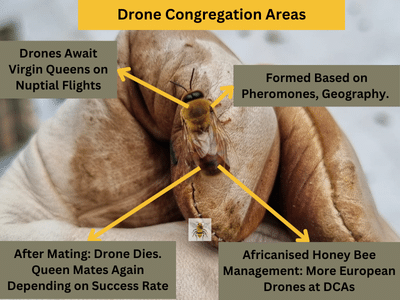
Drone Congregation Area (DCA) Pheromone: Drones release pheromones that attract other drones to specific areas (DCAs) where they gather to mate with queens.
Brood

Brood Recognition Pheromone (BEP): Developing larvae and pupae release BEP, which is crucial for maintaining colony stability by suppressing ovary development in worker bees.
Eggs
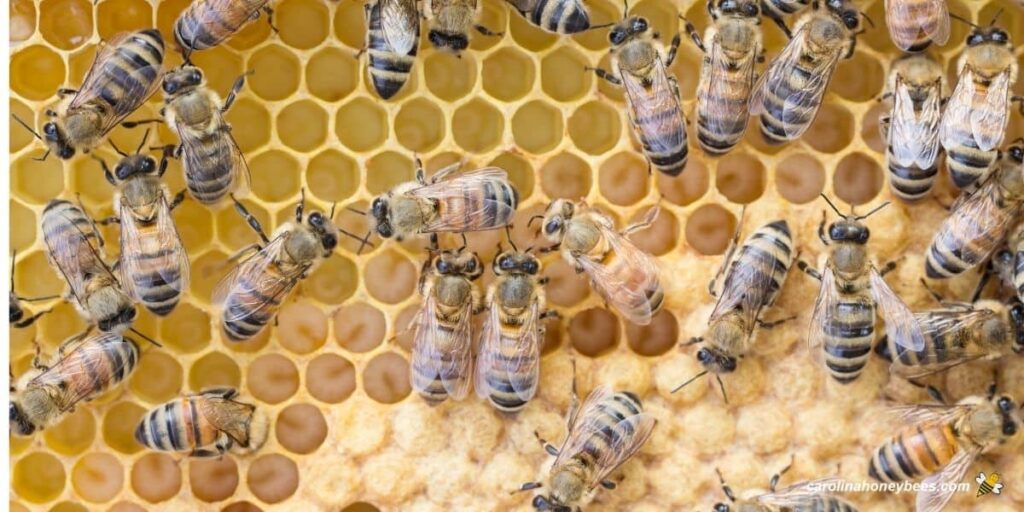
Dufour’s Gland Pheromone: This pheromone, produced by the queen, is found on eggs and may play a role in egg recognition by workers.
Egg-Marking Pheromone: This pheromone, distinct from Dufour’s gland pheromone, helps workers distinguish between queen-laid eggs and worker-laid eggs.
Video:
Honey bee communication: a multifaceted system
1. Dances: relaying location and urgency
- Waggle dance: This is the most famous honey bee dance, used to communicate the location of distant resources (typically >50 meters away), according to ThoughtCo. A successful forager performs a figure-eight pattern, with the central straight run (the “waggle run”) conveying crucial information.
- Direction: The angle of the waggle run relative to the hive’s vertical corresponds to the angle of the resource relative to the sun’s azimuth outside the hive.
- Distance: The duration of the waggle run indicates the distance to the resource.
- Quality: The intensity of the waggling can indicate the quality and quantity of the resource.
- Round dance: Used for nearby food sources (within about 50 meters of the hive), according to ThoughtCo. The dancing bee runs in small, tight circles, indicating only the presence and general direction of the food, not the exact distance.
- Sickle dance: This transitional dance pattern, a crescent-shaped pattern, is used for food sources located between 50 and 150 meters from the hive.
- Tremble dance: When a large amount of nectar has been brought back to the hive and needs processing into honey, a bee performs a tremble dance. The bee walks slowly and quivers its legs, causing its body to tremble, stimulating other bees to begin nectar processing.
- Shake dance: This dance signals that the colony needs more foragers to collect nectar from a rich source. The forager bee shudders in front of other house bees to encourage them to forage.
- Buzzing: Bees create a collective buzz to inhibit movement in cases of danger or to scare off predators. The intensity of the buzzing can also indicate the colony’s mood; a loud buzz may signal distress or anger.
- Buzz-Run: This is an alarm system where bees move quickly and erratically about the hive, buzzing their wings and bumping into other bees to alert them to a threat.
- Dorsoventral Abdominal Vibration (DVAV): These vibrations, primarily shaking the abdomen up and down, are involved in preparing a swarm for takeoff and stimulating scout bees to search for a new hive site.
- Stop signal: A bee will butt her head against a dancing bee, causing her to momentarily stop dancing. This signal may indicate a problem with the food source the dancer is promoting, such as a dangerous situation.
- Queen pheromones: The queen produces pheromones that maintain colony cohesion, regulate the behavior of worker bees, and prevent them from developing their ovaries.
- Alarm pheromones: When a bee stings, it releases an alarm pheromone, alerting other bees to danger and triggering a defensive response.
- Nasonov pheromones: Bees release this pheromone to mark a hive entrance, a new food source, or a new nest site.
- Brood pheromones: These pheromones signal hunger in the larvae and suppress worker bee ovarian development.
- Antennal contact: Bees use their antennae to touch other bees for identification and communication, especially during dances. They also use their antennae to taste nectar and assess its quality.
- Scent memory: Bees carry the scent of flowers back to the hive, which helps other bees locate the same food source.
Honey bee colonies have evolved to have a single, reproductively active queen because it optimizes colony fitness and survival in several ways. The presence of a single queen, who is solely responsible for laying eggs, prevents competition and infighting among multiple egg-laying females, which could destabilize the colony. Additionally, the queen’s pheromones play a crucial role in colony cohesion and worker behavior, and these benefits are maximized with a single, dominant queen.
1. Preventing Competition and In-fighting:
- Honey bee colonies are highly social, with a complex division of labor. The queen is the only reproductive female, and her primary role is to lay eggs.
- If multiple queens were present, they would compete for resources and mates, leading to conflict and instability within the colony.
- This competition could disrupt the colony’s ability to function effectively, potentially leading to its demise.
- The evolution of a single queen ensures that only one individual is responsible for reproduction, minimizing the risk of internal conflict.
2. Optimizing Queen Pheromone Control:
- The queen bee emits pheromones that influence the behavior and physiology of the worker bees.
- These pheromones signal the presence of a healthy queen and help to maintain colony cohesion.
- Having a single queen ensures that her pheromones are uniformly distributed throughout the colony, maximizing their effectiveness.
- A single, strong queen can better control the behavior of the workers, ensuring that they cooperate effectively and fulfill their various roles.
3. Facilitating Swarming and Reproduction:
- When a colony becomes too large or resources become scarce, the existing queen will initiate swarming.
- During swarming, the queen will leave the colony with a portion of the worker bees to establish a new nest.
- The remaining bees in the original colony will then raise a new queen to take her place.
- This process, while disruptive, allows for the successful reproduction and dispersal of the colony.
- A single queen simplifies the swarming process and ensures that the new colony has a dedicated reproductive female.
4. Other Considerations:
- The queen’s long life compared to worker bees and her ability to store sperm from multiple drones allows her to lay eggs throughout her life.
- This ensures a continuous supply of offspring, even when resources are limited.
- The colony’s survival and success depend on the queen’s health and reproductive capacity, which is why a single, healthy queen is essential.