
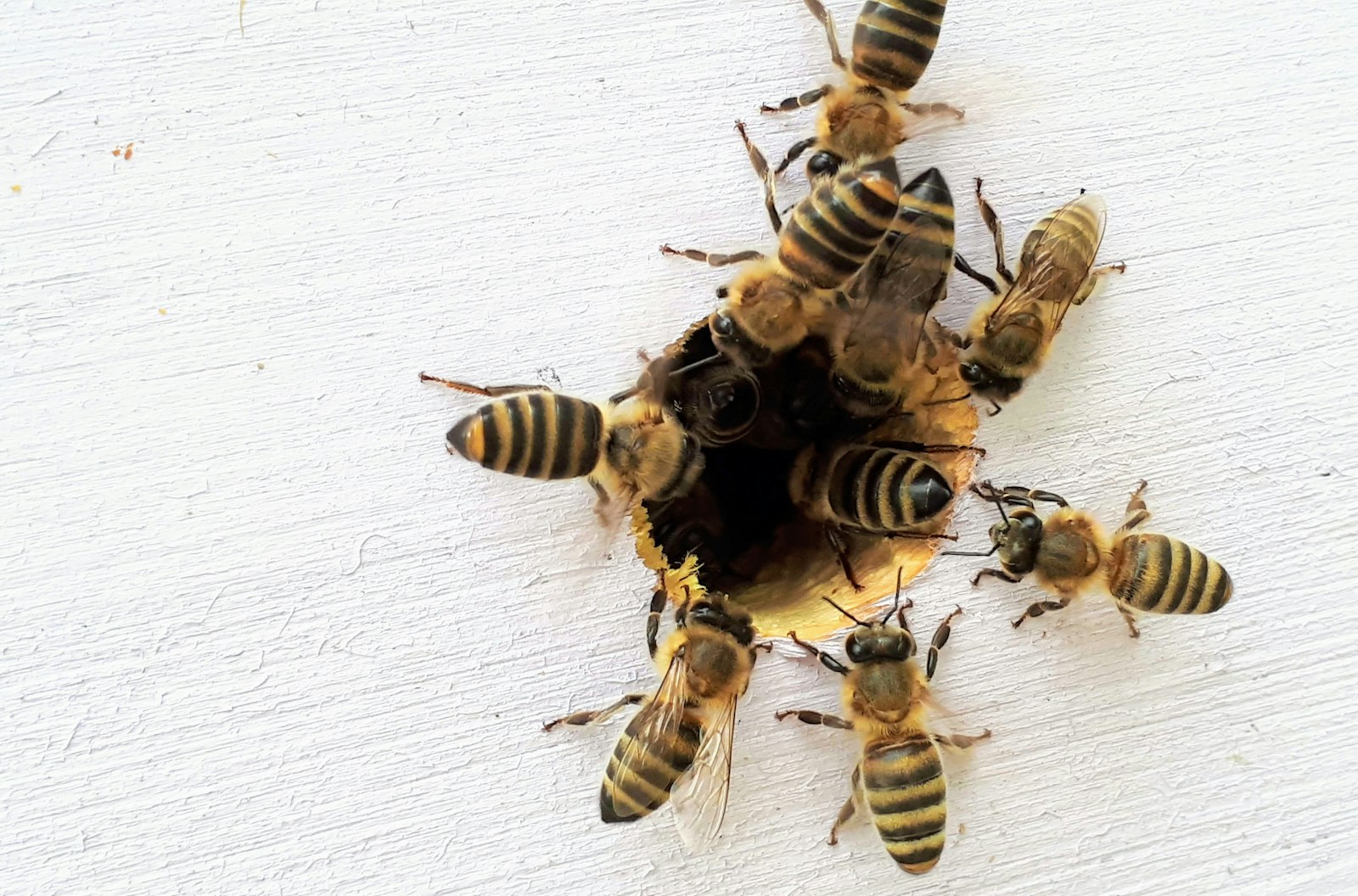
Bees recognize nestmates primarily by scent (cuticular hydrocarbons).
-
Each colony has a unique blend of wax, nectar, pollen, and queen pheromone odors.
-
Guard bees at the entrance use this “smell code” to admit or reject returning bees.
During robbing, the target hive’s guards become extremely defensive and will attack any foreign-scented bee. That defensive state can linger for several days afterward — so your concern is completely justified.
Cuticular hydrocarbons (CHCs) are a complex mixture of long-chain lipids that form the outermost, waxy layer of an insect’s cuticle. This chemical layer is essential for insect survival and plays a dual role in protecting against desiccation and mediating chemical communication.
Structure and composition
CHCs are a diverse group of compounds, with a single insect species often producing dozens or even hundreds of different types. They are characterized by their chain length and the presence of double bonds or methyl branches.
The main classes of CHCs include:
-
- n-alkanes: The simplest CHCs, which are straight, saturated chains of carbon and hydrogen atoms.
- n-alkenes and alkadienes: Unsaturated hydrocarbons that contain one or two double bonds along the carbon chain.
- Methyl-branched alkanes: Saturated hydrocarbons with one or more methyl groups:
−CH3negative CH sub 3
−CH3, attached to the main carbon chain.
-
- The position and number of these branches (e.g., mono-, di-, and trimethyl alkanes) affect the physical properties of the wax layer.
-
 :
:
Key functions of cuticular hydrocarbons? Protection against desiccation.
-
- Waterproofing: The layer of CHCs on the cuticle is highly hydrophobic, creating a barrier that prevents water loss through the insect’s body surface.
- Phase behavior: The composition of the CHC layer can change in response to temperature. The melting point of the hydrocarbons determines the fluidity of the waxy layer, which is crucial for balancing waterproofing needs with communication.
-
- Drier-climate species often have a higher proportion of longer-chain and more tightly packed alkanes to improve waterproofing.
-
Chemical communication (Semiochemicals)
CHCs act as semiochemicals, or chemical signals, that convey vital information between individuals, colonies, and species.
-
- Species recognition: Different insect species have unique CHC profiles, which helps prevent mating with other species. Distinct CHC profiles can evolve quickly and contribute to reproductive isolation, even in closely related species.
- Mate and sex recognition: CHCs often function as contact sex pheromones. These chemical cues can be sex-specific, signaling sexual maturity and triggering courtship and mating behaviors. In some species, CHCs from one sex can even deter courtship from males.
- Social and caste recognition: In social insects like ants, bees, and wasps, CHCs are fundamental to social organization.
-
- Nestmate recognition: Colony members share a common, or “Gestalt,” odor that allows them to distinguish between nestmates and intruders. This communal scent is maintained through physical contact, such as grooming and the exchange of bodily fluids (trophallaxis).
- Caste and fertility: Specific CHC profiles can indicate an individual’s caste (e.g., queen vs. worker) and reproductive status within the colony.
-
Factors influencing CHC profiles
The specific mix of hydrocarbons on an individual insect is influenced by both genetic and environmental factors, including:
-
- Genotype: The genetic makeup of an insect primarily determines its baseline CHC profile.
- Age and development: The CHC profile of an insect changes throughout its life cycle, with specific compounds and ratios shifting during maturation.
- Sex: Many species exhibit sexually dimorphic CHC profiles, with distinct differences in composition between males and females.
- Diet: The availability of resources and specific dietary components can influence the synthesis of CHCs.
- Environment: External conditions like temperature, humidity, and the surrounding microhabitat affect the optimal composition for desiccation resistance.
Applications of CHC analysis
The stability and specificity of cuticular hydrocarbons have made their analysis useful in several scientific fields:
- Forensic entomology: The chemical profiles of necrophagous insects (those that feed on decaying flesh) can help determine the post-mortem interval (PMI), as the CHC profile changes predictably with the insect’s age and environment.
- Taxonomy and systematics: Unique CHC profiles can serve as chemical fingerprints for discriminating between closely related, morphologically similar species.
- Museum specimens: The stability of CHCs means that profiles can be reliably extracted even from very old museum specimens, assisting in taxonomic and evolutionary studies.